


Listen to the article
French robotics company Wandercraft says Renault will deploy hundreds of Calvin-40 robots across factories in France and Spain, as it races to turn humanoid machines from pilot projects into production tools.
French robotics company Wandercraft is stepping up its bid to become a major name in humanoid automation, after saying it has won 12 significant customers in under a year and as Renault prepares a large-scale rollout of its machines in factories in France and Spain. According to reporting in Intelligent CIO and other industry outlets, the Renault programme is expected to become one of the clearest real-world tests yet of whether humanoid robots can move from pilots to production use at industrial scale.
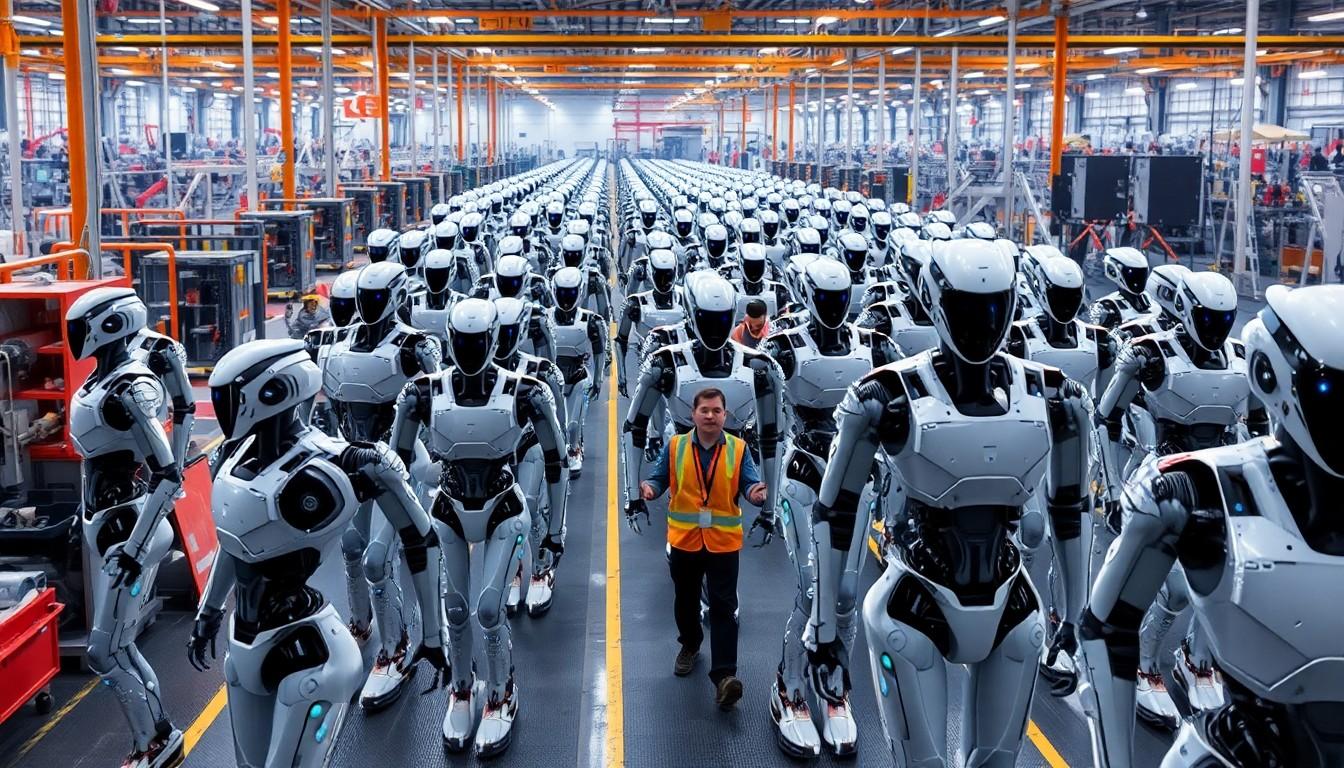
At the centre of that push is Calvin-40, an autonomous humanoid robot built for heavy, repetitive work in manufacturing and logistics. Wandercraft says the machine can lift up to 40kg and move cartons, crates and other materials between workstations while navigating independently using 3D vision, autonomous movement and adaptive control. The company says the robot is intended to work inside existing facilities without requiring changes to infrastructure, with the aim of easing physical strain on employees and freeing staff for more specialised tasks.
Renault’s involvement gives the programme particular momentum. Industry reports say the carmaker plans to introduce around ten Calvin robots by the end of 2026, before expanding to roughly 350 units across its French and Spanish plants by the end of 2027. Wandercraft has presented the partnership as both a commercial breakthrough and a route to industrial-scale manufacturing, while Renault’s own roadmap suggests the company is still working through the practical challenge of training robots for factory conditions. Trial work at Renault’s Douai site has already included night-shift tyre handling, underlining how the technology is being tested in physically demanding roles that have traditionally relied on human labour.
The company is backing its ambitions with new production capacity in Paris. Wandercraft opened a 4,300 square metre headquarters on 5 October 2026 that brings research and development, assembly and maintenance under one roof, with 800 square metres devoted to building, storing and servicing robots. The site is said to have capacity for one robot an hour, and the company has gone further by setting a long-term target of making one million robots a year, with production intended to remain largely European.
Wandercraft is also broadening its business beyond industry through its acquisition of Ekso Bionics, announced in October 2026. That move strengthens its position in medical exoskeletons, the field in which it built its reputation, and extends its reach in the United States as well as into personal mobility. Together, the Atalante X and EksoNR systems are already used in more than 700 rehabilitation centres worldwide, giving the company an established base from which to pursue its much larger humanoid robotics ambitions. For now, the central question is whether Wandercraft can convert early customer interest into sustained output, and whether autonomous robots can prove dependable enough to work alongside factory teams at scale.
Source Reference Map
Inspired by headline at: [1]
Sources by paragraph:
Source: Fuse Wire Services