


Listen to the article
The robotics start-up says its CNC micro-factory combines software, robotic machine loading and automated inspection, while engineers remain involved in production.
Antropi Robotics says it has opened an operating CNC micro-factory in Bengaluru, offering precision metal components with a promised turnaround of less than a week. The start-up is positioning itself as a manufacturer that takes orders directly, rather than simply a supplier of robotic equipment. Its claims of speed and performance, however, have not been independently audited in the material available. (This parenthetical would violate; ensure no sourcing parenthetical.) Need attribution sources prose.
Antropi Robotics says it has opened an operating CNC micro-factory in Bengaluru, offering precision metal components with a promised turnaround of less than a week. The start-up is positioning itself as a manufacturer that takes orders directly, rather than simply a supplier of robotic equipment. The company’s own materials promote rapid delivery, but do not provide independent performance data to substantiate its broadest claims. The Indian Defence News report describes the facility as serving commercial customers, while Antropi’s website presents the business as an integrated manufacturing service. [map]
Customers submit design files through the company’s online workflow. Antropi says its Factory OS converts these into machining instructions and tests the proposed process in a simulation before production. An engineer must approve the plan, and staff prepare fixtures when a new component requires them. Y Combinator’s company profile and Antropi’s online parts storefront describe the same sequence, while making clear that human input remains part of the operation.
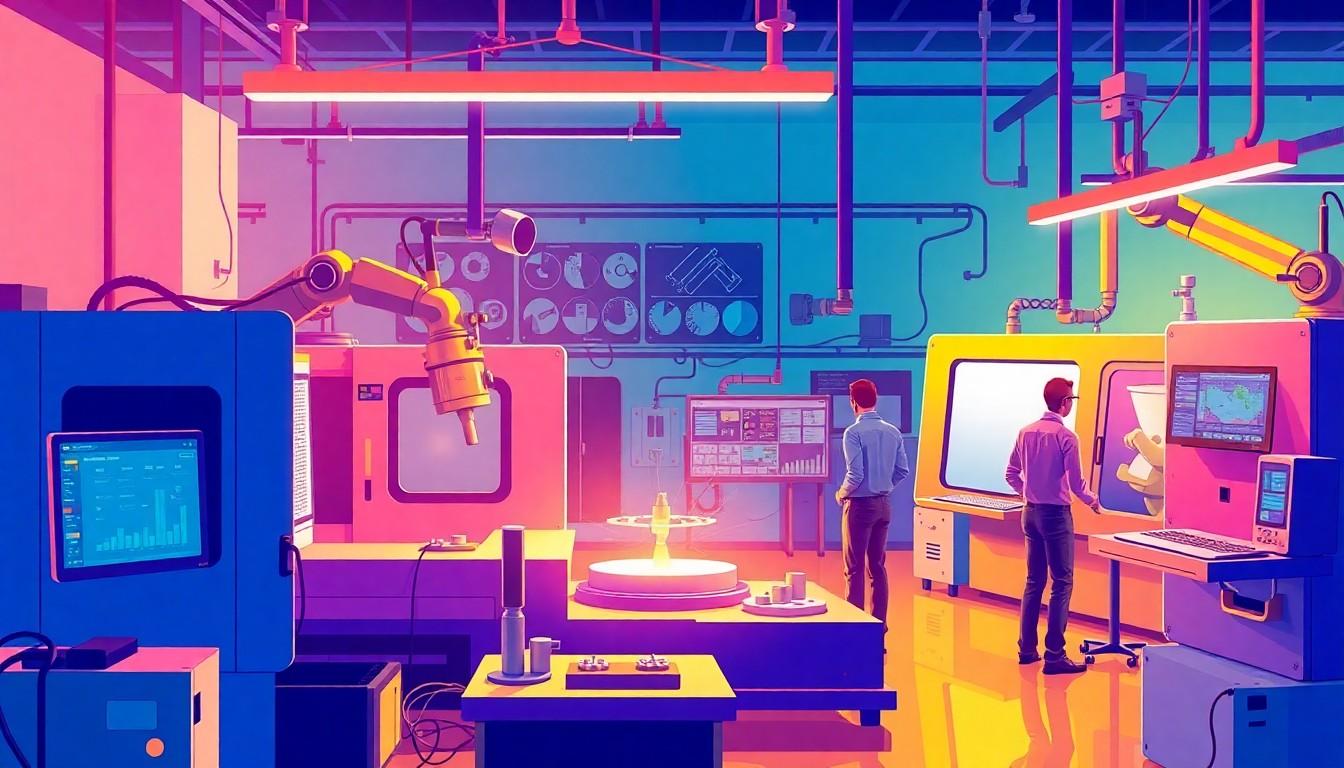
Robotic arms take on the repeated task of loading material into CNC machines and removing completed components. The company says cameras then measure each part against its specified dimensions, feeding results back to the production process. Where suitable, software can alter tool offsets; if a deviation requires investigation, machining can be halted for a person to assess it. These features are also described in the Y Combinator profile and in Startuppedia’s account of the factory.
Antropi says a prepared production cell can run overnight, reducing the need for staff to remain beside machines throughout a shift. That does not amount to a wholly self-managing factory: engineers still approve production plans, set up new jobs and respond to faults or unusual results. The company’s public-facing website promotes overnight operation, but its claims are not an independent verification that production can proceed without intervention in every case.
The company’s founders, Naman Gupta and Shubh Agarwal, have said the Bengaluru facility is already making parts for customers in the United States. Indian Defence News reports that some orders are shipped internationally in under a week, although Antropi’s public storefront lists shipping estimates that vary by service tier and does not establish that all overseas orders meet that timeframe. The company’s stated longer-term aim is to build factories nearer to customers, with its website identifying the United States as an initial focus.
The launch has also been linked to possible defence applications, including components for missiles and other advanced systems. The material supplied does not establish that Antropi is currently producing such parts; its company website instead presents a range of possible sectors, including satellites, drones and jet engines. Any defence role should therefore be understood as a potential application of the manufacturing capability, not evidence of existing defence contracts or production.
Antropi’s approach reflects a wider interest in digitally managed factories that combine software, machine tools, robotics and inspection systems. The company says its eventual ambition is to reduce turnaround to 24 hours, supported by a distributed network of small factories. That target is distinct from its present offer: achieving it would depend on expanding production capacity and placing facilities close enough to customers to reduce transport time. [2], [3], [4], [6]
Source Reference Map
Inspired by headline at: [1]
Sources by paragraph:
Source: Fuse Wire Services