


Listen to the article
Four organisations tested how banks could verify an AI agent’s identity and authority, check proposed payments against client rules and keep an auditable record , in a proof of concept, not a live customer service.
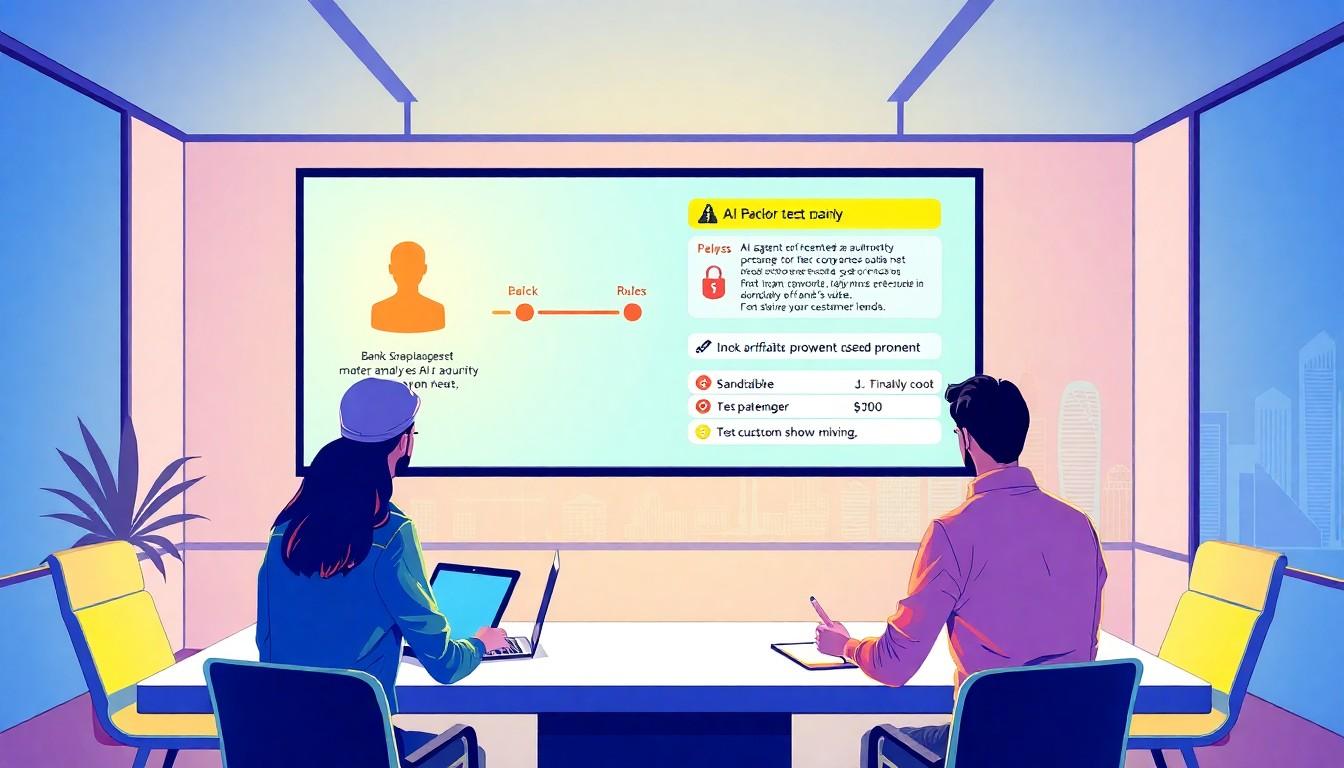
Four organisations have used a controlled trial under the Monetary Authority of Singapore’s PathFin.ai initiative to examine how financial institutions might check and govern actions proposed by AI agents. Green Link Digital Bank, AXS, Terminal 3 and HSBC Singapore tested safeguards spanning an agent’s identity, its authority to act for a client, the controls applied to its requests and the records left behind.
The work followed MAS’s Safeguards for Agentic Finance at Runtime framework, known as SAFR. The framework focuses on assessing proposed financial actions before they are carried out: institutions need to establish who or what is making a request, whether it has permission to do so and whether the action complies with the relevant rules. The MAS paper also highlights the need to retain decision records that can later be reviewed. These principles were explored in the trial, rather than demonstrated as a live customer service.
Two scenarios were tested. In one, an agent acting for a client checked a biller’s account details, obtained billing information and sent a payment instruction through existing payment systems. In the other, a registered external agent sought corporate account information and submitted a payment request on behalf of a treasurer. The tests considered how a bank could check the agent’s identity and mandate, apply the client’s conditions and obtain confirmation before proceeding.
Terminal 3 supplied the trust infrastructure used to verify the agent, the party it represented and the actions it was permitted to take. Its system also assessed requests against client mandates and created a tamper-evident record of decisions. That emphasis on identity, permissions and evidence reflects the governance issues highlighted in the programme for the Insights2040 Annual Meetings, where participants discussed how to maintain accountability as AI agents take on commercial and treasury tasks.
AXS said it was making its bill-payment network available to AI-powered partners through its MCP server. Bill payments may offer a practical area for early experimentation because the intended outcome can be clearly specified and checked, although the trial did not amount to the launch of autonomous payments. PathFin.ai’s wider role is to support the exchange of practical experience about AI in financial services; it forms part of a broader effort to develop applications, tools and risk-management approaches for the sector.
The proof of concept sits alongside Singapore’s wider exploration of agent-led financial activity. A separate proposed sandbox is intended to let institutions test transactions involving digital money, including payments released only when specified conditions have been met. Such initiatives underline the distinction between testing and deployment: even where an agent initiates a request, the institutions and organisations it represents remain responsible for ensuring that the action is authorised and properly controlled.
Source Reference Map
Inspired by headline at: [1]
Sources by paragraph:
Source: Fuse Wire Services