


Listen to the article
SoluLab says its platform combines scanned maintenance files, market data and predictive models to assess engine value and purchase risk, but its performance figures have not been independently verified.
Buying a used aircraft engine depends on more than its age or advertised price. Its maintenance condition, the remaining life of parts subject to mandatory limits, the timing and cost of future work, and demand for the aircraft it powers can all affect what it is worth. Fitch Ratings’ aircraft-finance criteria emphasise that maintenance status can outweigh age in assessing an engine, while market prospects are linked to the aircraft’s place in its production cycle.
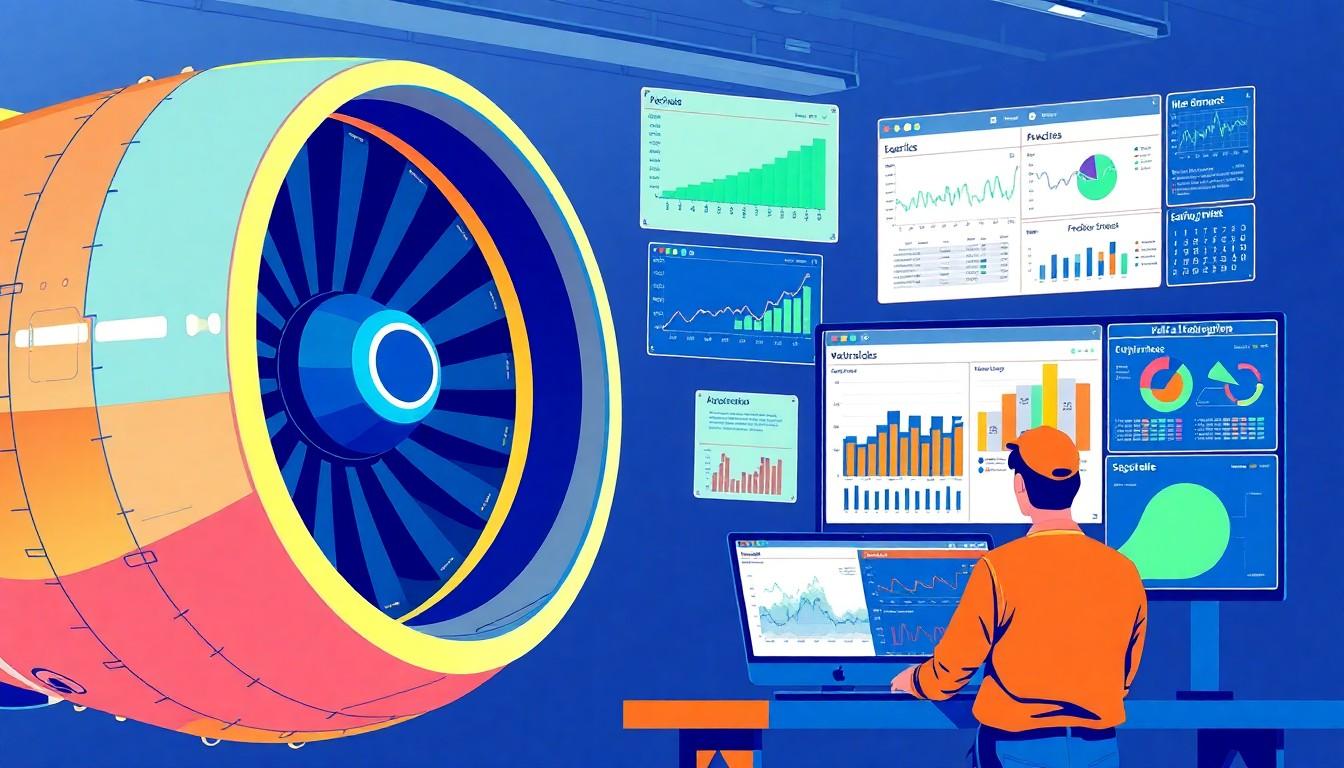
A SoluLab case study describes a proposed platform designed to bring those considerations together. It begins by turning scanned maintenance files, including engine mini packs and shop-visit records, into structured information. The company says its system uses Tesseract optical character recognition alongside natural-language-processing tools to identify details such as cycle counts, repairs and maintenance schedules. Tesseract’s documentation confirms that the software can recognise printed text in images, but OCR alone cannot ensure that the resulting technical data is correct; errors in the source information could affect every calculation that follows.
The platform then uses the extracted records alongside market information and past transactions to estimate an engine’s current value. SoluLab says its approach includes XGBoost and Random Forest models, followed by forecasts of future value and estimates of remaining useful life using time-series, survival-analysis or LSTM techniques. The rationale for looking beyond a present-day price is clear in aviation appraisal: AVITAS distinguishes between market-based values and figures adjusted for maintenance condition, including expected overhaul work and life-limited-part costs.
The purchase assessment is intended to compare a seller’s price with the platform’s estimated value after anticipated maintenance expenditure has been taken into account. That distinction matters because an asking price on its own does not reveal whether an engine is a sound purchase. Industry data services reflect the same broader need to combine market information with maintenance economics: the International Air Transport Association says its MRO Insights service provides fair-market values and maintenance-cost information to support procurement, sales and valuation.
SoluLab says recommendations would include a confidence score and an explanation of the factors behind the result, such as remaining life in life-limited parts, upcoming work and comparable sales. This is relevant to a decision involving a high-value asset, where buyers may need to scrutinise or challenge the reasoning rather than accept a score at face value. Guidance hosted by the National Institute of Standards and Technology describes explainability as a way to help people understand model decisions and support trust and debugging, while cautioning in effect that an explanation is useful only if it genuinely reflects how the system behaves.
The case study also describes a wider technical set-up, with data from manufacturers, maintenance providers, market sources and historical transactions feeding into a shared data environment. SoluLab outlines a web interface for document processing, valuation, purchase assessment and market analysis, and says the system can be deployed in an operator’s cloud with controlled access and encryption. These are features claimed in the company’s account; the material supplied does not independently assess the platform’s security, model ownership arrangements or practical performance.
SoluLab reports document-extraction accuracy above 90 per cent, valuation error below 10 per cent, purchase-evaluation accuracy above 90 per cent, an 80 per cent reduction in evaluation time and 70 per cent less manual document review. The company presents these as case-study results, not as independently verified benchmarks or evidence that the same performance would hold across the industry. The reported efficiency gains point to the potential value of automating document-heavy work, but the figures should be read alongside the quality of the underlying records and the assumptions used to estimate maintenance costs and market value.
Source Reference Map
Inspired by headline at: [1]
Sources by paragraph:
Source: Fuse Wire Services