

Listen to the article
TechNovator unveils a revolutionary wireless charging system capable of powering multiple devices over 30 centimetres with near-perfect efficiency, promising new applications from medical implants to e-vehicles.
TechNovator unveiled at CES 2026 a wireless charging system the company says can deliver power across distances of up to 30 centimetres with transfer efficiencies approaching 95 percent, promising a step-change from conventional inductive pads that require precise alignment. According to the report by Tech Times, CEO and co-founder Ruslana Dovzhyk presented a system developed over 11 years that uses a “microstructured energy interface” based on principles the company describes as energy quantization. [1][2]
The demonstration at CES showed multiple practical use cases: a charging table with two transmitters beneath a plastic surface powering lamps, a modified rechargeable computer mouse and stacked devices drawing power simultaneously from a single cable-connected point. Dovzhyk demonstrated devices charging while in motion across the surface and said, “It’s possible to charge many devices simultaneously, low, medium, and high power devices, over a distance with high efficiency,” and “And it’s possible to charge in various environmental conditions, even in motion.” These claims, reported by Tech Times, underline the company’s pitch of seamless, multi-device charging. [1]
TechNovator says its system does not rely on conventional magnetic or strong electric fields and that between transmitter and receiver only a weak information-carrying signal is detectable rather than the energy itself. The company claims this stealth profile produces no radiation, interference or excess heat, and that the weak detectable signal contributes to safety for users and bystanders. According to the TechNovator website and the CES coverage, that safety aspect is central to proposed applications in environments with continuous human presence. [6][1]
The company stressed medical applications as a priority area. TechNovator claims the technology can safely transfer power through tissue and could potentially charge implantable devices such as cardiac pacemakers and brain stimulators, reducing the need for repeat surgeries to replace batteries. Industry observers note such uses require rigorous clinical testing and regulatory approval before clinical rollout, but TechNovator presented the capability as a core potential market. [1][6]
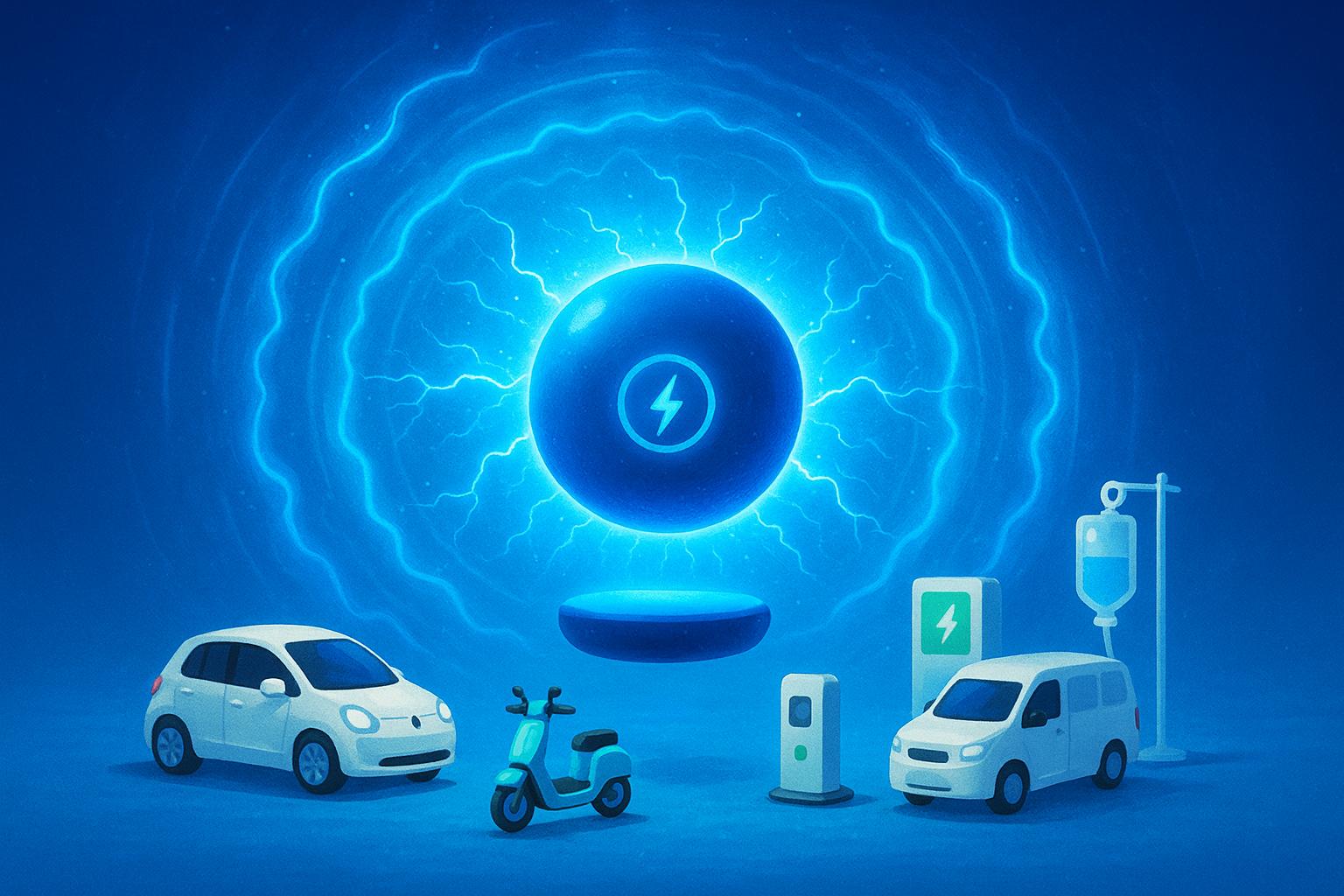
Beyond medical devices, TechNovator is positioning the system for micromobility, robotics and electric vehicles. The company says it has already demonstrated charging half-kilowatt batteries and plans tests for EV systems capable of 10 kilowatts or more. Tech Times reported scenarios including e-bikes or e-scooters charging on weatherproof platforms, and warehousing robots that could operate continuously rather than returning to docking stations. The company expects consumer electronics, robotics and micro-mobility to be the earliest market entries. [1]
Integration into existing products will, the company acknowledges, require addition of its receiving elements and electronics. TechNovator showed receivers in multiple sizes and form factors, including flexible variants intended for slim devices, and said the only notable limitation is that complete metal barriers will block the signal; perforated metal still allows transfer. The company is actively seeking partnerships with device manufacturers ahead of demonstrations planned for Mobile World Congress in Barcelona. [1]
TechNovator’s claims sit alongside other industry activity showcased at CES and beyond. Established accessory makers are iterating on Qi-based magnetic and modular fast-charging products, and earlier long-range demonstrations have been shown by other startups at previous shows. According to coverage of CES exhibitors and product launches, the market is seeing both incremental improvements to standards such as Qi2 and novel approaches to over-the-air and long-range power. That context suggests significant engineering, safety and standards work will be needed before widespread adoption of any radically different wireless-power modality. [3][4][5]
If TechNovator’s energy-quantization approach proves repeatable and scalable, it could address persistent limitations of today’s wireless chargers: the need for precise alignment, short effective range, difficulty charging multiple devices efficiently and sensitivity to environmental conditions. The company says patent publications and further demonstrations will follow as partners and industry stakeholders evaluate whether the claimed efficiencies and safety characteristics translate to commercial deployments. [1][6]
📌 Reference Map:
Reference Map:
- [1] (Tech Times) – Paragraph 1, Paragraph 2, Paragraph 3, Paragraph 4, Paragraph 5, Paragraph 6, Paragraph 8
- [2] (Tech Times summary) – Paragraph 1
- [6] (TechNovator website) – Paragraph 3, Paragraph 4, Paragraph 8
- [3] (AUKEY CES coverage) – Paragraph 7
- [4] (MacRumors CES coverage) – Paragraph 7
- [5] (AeroCharge CES 2025) – Paragraph 7
Source: Fuse Wire Services