


Listen to the article
A connected factory platform has improved equipment effectiveness, lifted operator productivity and helped Boehringer Ingelheim meet rising demand while avoiding new-site emissions and capital costs.
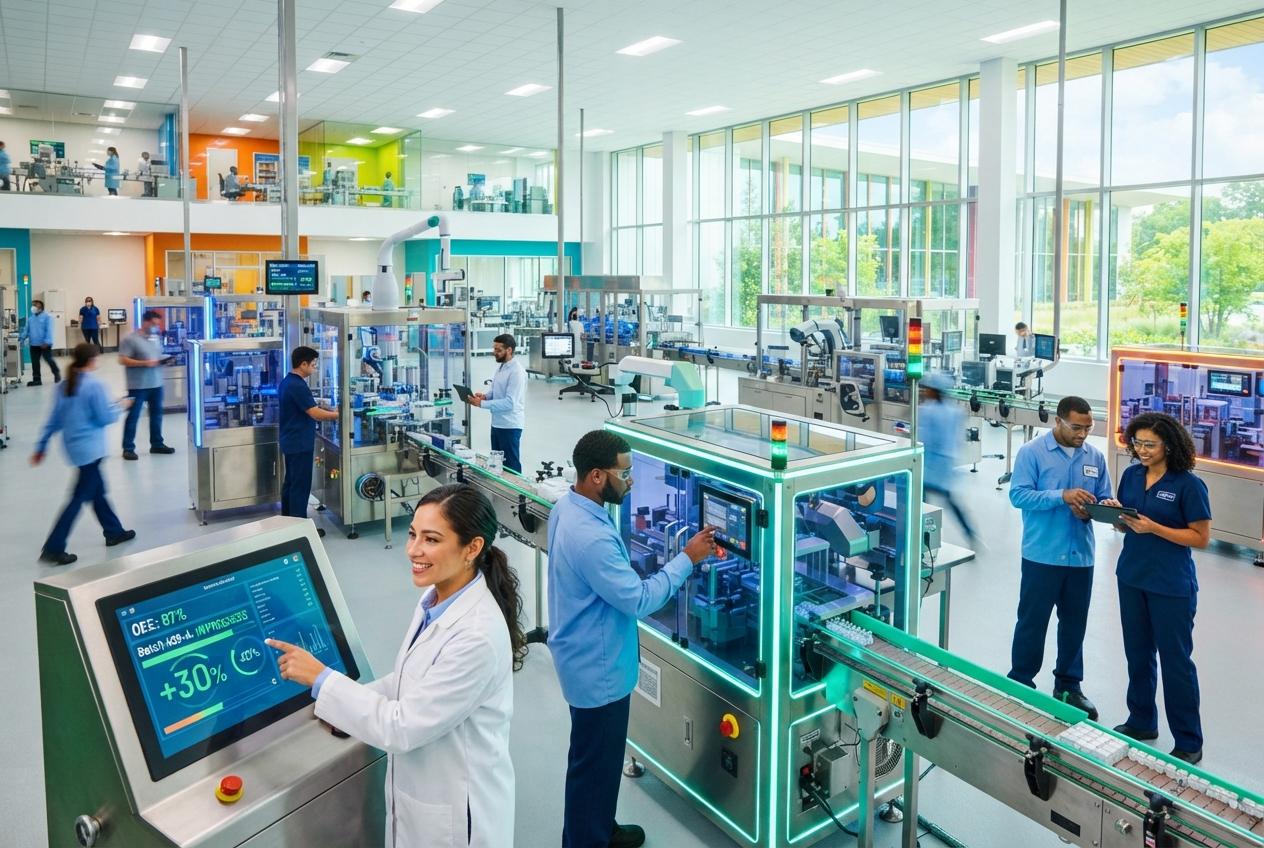
Boehringer Ingelheim’s effort to create a more connected factory floor has delivered gains that extend well beyond efficiency. According to EY’s case study, the pharmaceutical group digitised shop floor activity with ServiceNow’s Connected Manufacturing Platform and used real-time data to expose losses as they occurred, helping lift overall equipment effectiveness by 20% to 30%. The company said this came through quicker problem-solving, more reliable execution and a sharp reduction in the manual work that had previously absorbed operators’ time.
The operational changes were matched by a broader shift in how work was carried out. By automating routine administration and improving visibility across production lines, the company gave frontline teams more room to concentrate on higher-value tasks and continuous improvement. Early-adopter sites also saw operator productivity rise by 35%, while a unified system shortened machine onboarding from more than two days to just 2.5 hours, regardless of legacy factory setups, according to a separate account of the project.
The environmental implications were significant. Boehringer Ingelheim said the productivity improvements allowed it to meet rising demand without building new plants, avoiding capital spending as well as the Scope 1 and Scope 2 emissions that would have been associated with additional facilities. That sits alongside the company’s wider sustainability reporting, which says its own greenhouse gas emissions have fallen by 48% against a 2019 baseline, while renewable electricity now accounts for 82% of its supply.
Equally important was the change in workplace culture. EY’s case study says shop floor adoption was strong, with operators becoming more active in performance improvement and taking greater ownership of results. Managers, meanwhile, gained a common, live view of operations that supported faster, better-informed decisions and improved alignment across sites. Marinie Voutsina, Boehringer Ingelheim’s Operational Excellence Lead, said EY had played a “pivotal role” in helping the company achieve Operational Excellence Prime and steer its operations towards a more sustainability-driven model.
The platform was designed with scale in mind. Built on ServiceNow and supported by a standard manufacturing excellence framework, it can be replicated across sites and countries, turning what began as a pilot into a rollout model for global deployment. That approach reflects a wider shift in manufacturing, where companies are moving away from isolated digital experiments towards connected operating systems that combine data, analytics, automation and workforce experience. Boehringer Ingelheim’s case suggests the real value lies not in technology alone, but in embedding it into daily work so that efficiency, resilience and sustainability advance together.
Source Reference Map
Inspired by headline at: [1]
Sources by paragraph:
Source: Fuse Wire Services