


Listen to the article
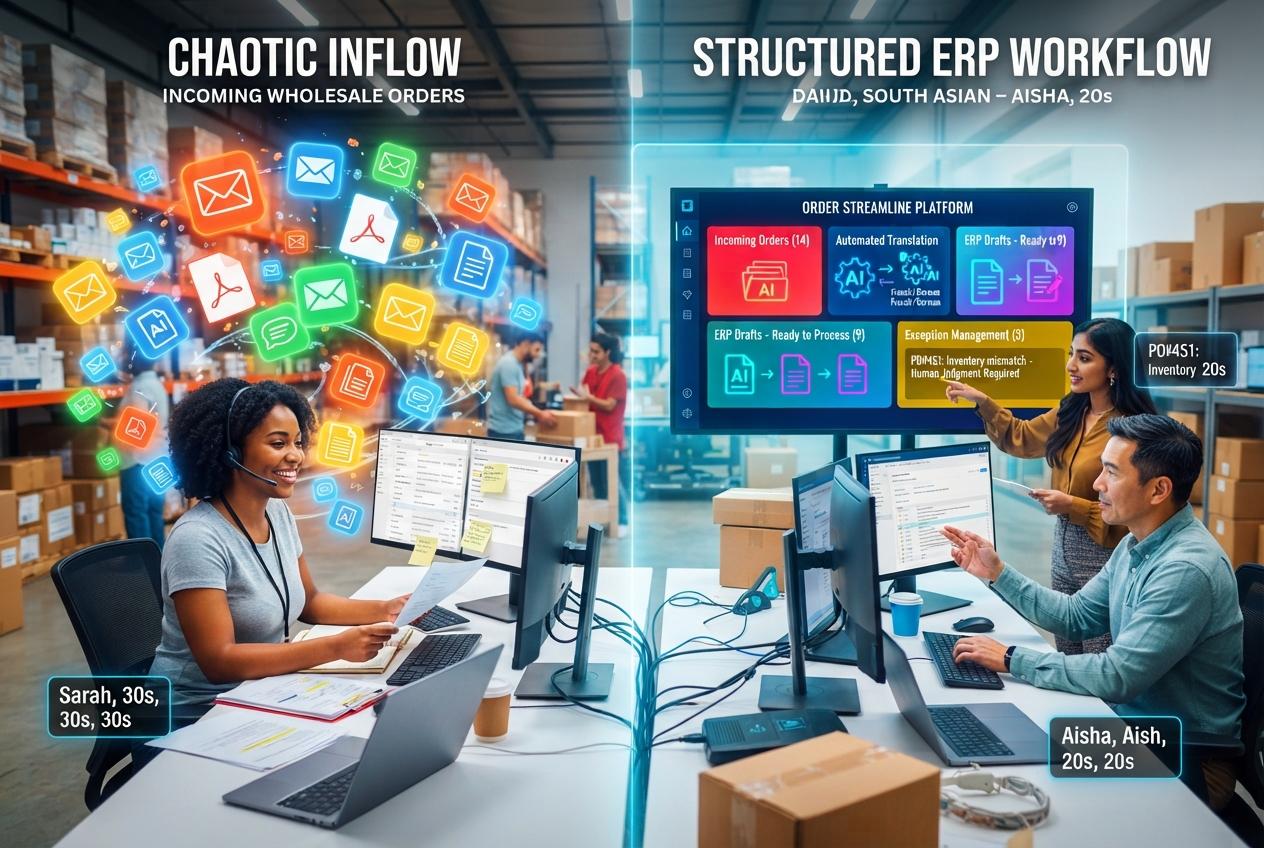
Distributors are using AI to translate emails, PDFs, messages and handwritten orders into structured drafts, while leaving staff to resolve the exceptions that require commercial judgement.
Wholesale distributors have spent years automating warehouses, transport and stock control, yet one stubborn bottleneck often remains at the front end of the business: order entry. Customer orders still arrive as emails, PDFs, spreadsheets, text messages, WhatsApp notes and even photographs of handwritten forms, leaving staff to decipher product descriptions, check quantities and type the details into the ERP before anything can move to picking or invoicing.
That manual work is more than an administrative nuisance. As Infios notes in its overview of wholesale distribution, distributors may be dealing with huge catalogues and an equally unpredictable mix of customer formats, which means volume quickly turns into a processing constraint. In practice, the people handling orders become translators between the customer’s language and the distributor’s system, a role that is essential but slow, repetitive and difficult to scale.
The promise of AI in this setting is not fully autonomous ordering, but structured assistance. According to the Good Men Project article, modern AI tools can read disparate documents, identify line items and suggest matches to catalogue records while flagging uncertain cases for review. SourceX makes the same point from a quoting and order-entry angle, saying systems can learn from paired records such as requests for quotation and the resulting quotes, or emailed purchase orders and the entries that were keyed from them. The value lies in converting unstructured customer communication into a draft order that a person can confirm rather than having to build from scratch.
Food wholesalers are already using that approach to keep customer behaviour unchanged while improving internal efficiency. The Open Pantry describes a workflow in which AI can ingest emails, texts, WhatsApp messages, voicemails and PDF purchase orders, identify the customer, map each line to the right SKU and apply the relevant price list before presenting a draft for approval. That matters because the best automation does not force customers to adapt to a new channel; it absorbs the formats they already use and turns them into something operationally useful.
Even so, the most effective systems leave judgement with staff. Negotiated terms, substitute rules, stock shortages, credit limits and delivery constraints all require business context that may not be visible in a document. As the Good Men Project article argues, the safest model is threshold-based: straightforward, low-risk lines can pass through with minimal review, while unusual products or conflicting information should trigger human scrutiny. SourceX adds that every correction should be captured, not hidden, so the system can improve from approved edits and better recognise recurring customer patterns.
Implementation quality matters as much as the technology itself. Ahoosh.ai says successful deployments depend on three layers: clean ERP integration, accurate matching of incoming order lines to the SKU catalogue and a clear exception process for human intervention. Ordana.ai similarly warns that projects often fail when catalogues are messy, master data is inconsistent or teams are not prepared for the change. That is why many distributors begin with a narrow pilot, such as one branch, one order channel or a cluster of high-volume customers, and track measures including time from receipt to ERP entry, error rates, correction volumes and the proportion of lines handled without manual rework.
The broader case for AI order entry is straightforward: distributors can take on more business without adding the same level of administrative headcount, while skilled staff spend more time on customer service, sourcing and problem-solving. Used well, the technology does not replace the people who understand the trade. It gives them a cleaner, faster first pass at the work, and frees them to deal with the exceptions that actually require judgement.
Source Reference Map
Inspired by headline at: [1]
Sources by paragraph:
Source: Fuse Wire Services