


Listen to the article
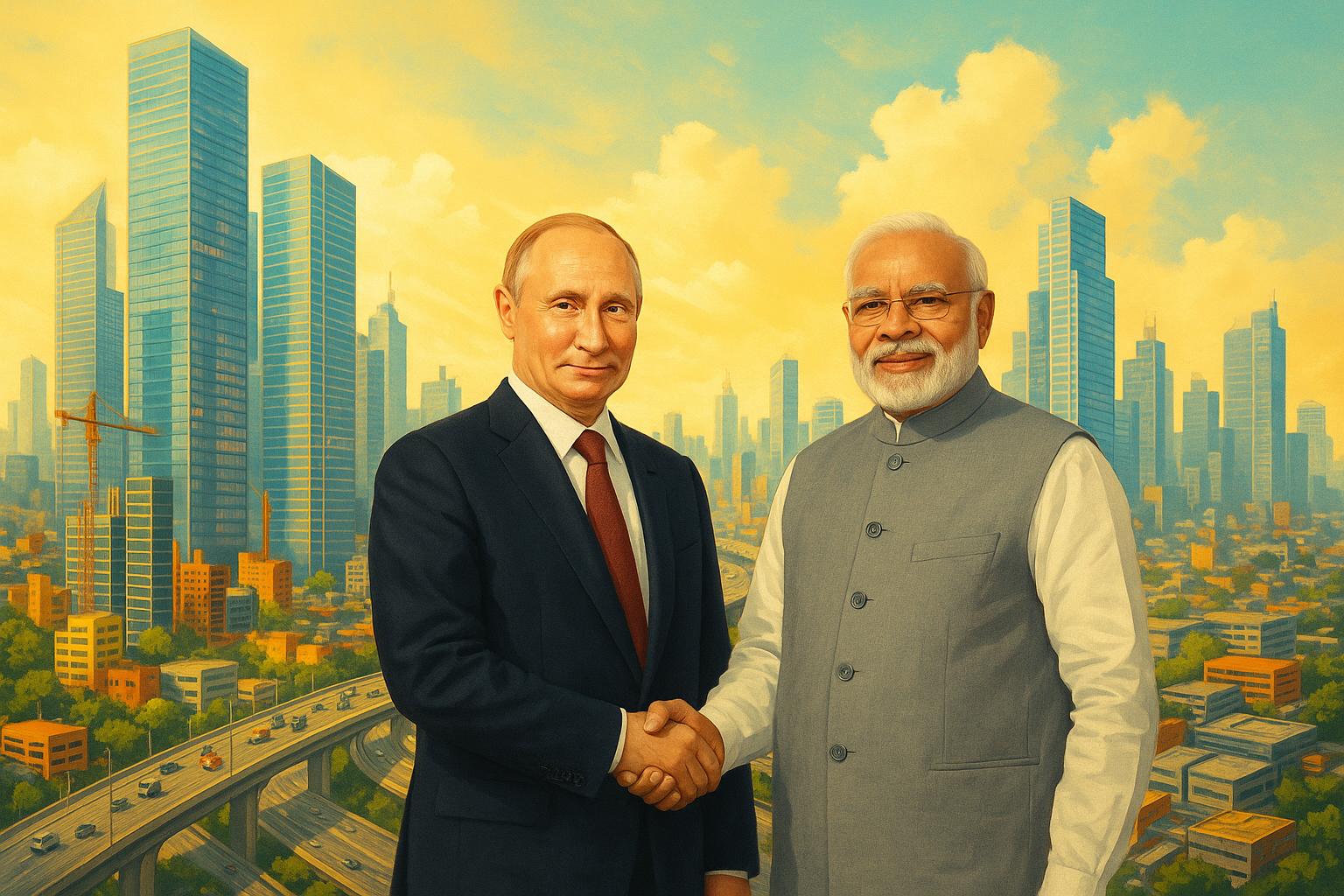
During President Vladimir Putin’s visit to India, a comprehensive roadmap was unveiled to expand economic ties beyond energy and defence, aiming to reach a $100 billion bilateral trade volume by 2030, supported by new agreements in multiple sectors amid geopolitical complexities.
Russian President Vladimir Putin’s state visit to India has crystallised a renewed push to broaden economic ties beyond the traditional pillars of energy and defence, with both leaders unveiling a comprehensive cooperation roadmap aimed at lifting bilateral trade to $100 billion by 2030. According to the original report, the summit marked 25 years of the India–Russia Strategic Partnership and saw agreements spanning fertilisers, shipbuilding, labour mobility and civil nuclear cooperation. [1][2][3]
Market analysts said the announcements are likely to be received as constructive by Indian equity markets, particularly for sectors tied to defence manufacturing, energy, infrastructure and critical minerals. Industry data shows India–Russia trade stood near $68–70 billion in the last fiscal year, giving the $100 billion target a credible but ambitious trajectory. [1][2][7]
Strategic and corporate voices emphasised that the roadmap can act as a structural positive rather than a short-term market catalyst. “While the India–Russia partnership provides structural long-term positives for several sectors and supports a more diversified strategic footprint for India, the delayed India‑US trade agreement is a moderating factor that markets will watch closely,” said Sugandha Sachdeva, Founder of SS WealthStreet, reflecting the cautious market view. [1]
Defence and aerospace firms are expected to be among the direct beneficiaries of deeper cooperation, with joint ventures and technology transfer likely to accelerate Make in India initiatives. Reuters reporting noted specific defence cooperation agreements and commitments to scale joint production, while analysts pointed to potential upside for state and private engineering names as projects move from memoranda to implementation. [2][1]
Energy and fertiliser ties were prominent in the discussions: uninterrupted fuel supplies, cheaper grades of crude such as Urals and expanded fertiliser cooperation were highlighted as measures that could stabilise input costs for refiners and agricultural supply chains. Investment in civil nuclear projects, notably the Kudankulam plant, was also reiterated as a strategic priority. These developments support forecasts that Indian refiners and downstream petrochemical players will see more predictable feedstock flows. [2][1][3]
Financial and trade infrastructure moves accompanying the summit bolster the economic case. Reuters and local reporting show Russian banks have sought regulatory approval to open branches in India and Russia’s central bank has opened an office in Mumbai, while major Russian banks aim to facilitate increased trade and labour mobility. Industry commentary also noted steps to promote rupee–rouble settlements to mitigate reliance on dollar-denominated transactions amid sanctions pressure. [4][5]
Market strategists flagged risks that could temper near‑term equity enthusiasm: geopolitical headwinds, potential secondary sanctions, supply‑chain disruption, and the broader diplomatic balancing act with the United States. AP reporting and commentary underscore that U.S. pressure remains a live factor and that the strategic pivot carries economic as well as political complexity. “We view this deal not as a tactical trade but as a structural variable shaping India’s strategic autonomy narrative,” one portfolio manager observed. [6][3][1]
For investors, analysts set out specific stocks and sectors to watch: defence manufacturers, shipyards and engineering contractors for large projects; refiners and petrochemical names for feedstock stability; mining and metals companies tied to critical minerals and EV supply chains; and select technology and pharmaceuticals exporters as bilateral market access improves. Experts cautioned that benefits are likely to accrue over the medium term as agreements are operationalised rather than immediately after the summit. [1][2][3]
Overall, the summit appears to have reinforced a long‑term commercial and strategic rhythm between Moscow and New Delhi that markets will price into sectoral themes over time, even as diplomacy and sanctions dynamics shape the pace and scale of tangible outcomes. Government and corporate statements made during the visit framed the agenda as practical and trade‑oriented, while analysts emphasised that implementation and regulatory steps will determine the near‑term market impact. [2][1][5]
📌 Reference Map:
##Reference Map:
- [1] (LiveMint) – Paragraph 1, Paragraph 2, Paragraph 3, Paragraph 5, Paragraph 8, Paragraph 9
- [2] (Reuters , Putin-Modi summit) – Paragraph 1, Paragraph 4, Paragraph 5, Paragraph 8, Paragraph 9
- [3] (AP News , summit outcomes) – Paragraph 1, Paragraph 5, Paragraph 8, Paragraph 9
- [4] (Reuters , Russian banks seek approval) – Paragraph 6
- [5] (Reuters , Sberbank/exports & labour) – Paragraph 6, Paragraph 9
- [6] (AP News , geopolitical context) – Paragraph 7
Source: Noah Wire Services