


Listen to the article
Next-generation Nvidia GPUs and server racks are prompting a significant leap in cooling system costs, highlighting the escalating challenge of thermal management in high-performance AI infrastructure.
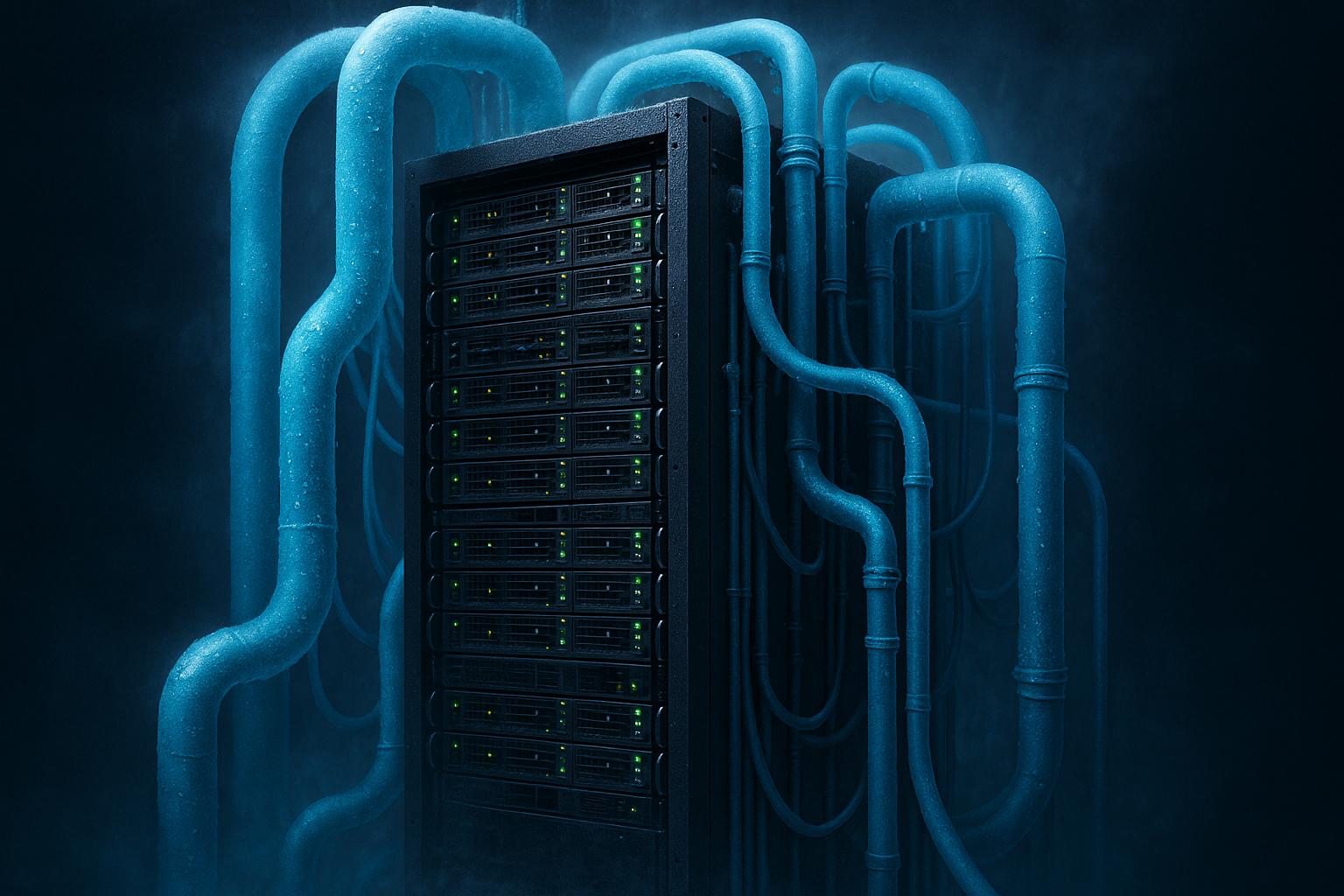
Nvidia’s cutting-edge AI server racks are pushing the boundaries of liquid cooling technology, with a significant financial and technical investment required to manage the intense thermal output generated by these powerful systems. According to a recent Morgan Stanley report, the cooling system within a single Nvidia GB300 NVL72 rack-scale AI system carries a staggering bill of materials (BOM) cost of nearly $50,000. This figure is set to rise by approximately 17%, reaching an estimated $55,710 for the company’s forthcoming Vera Rubin NVL144 platform, owing to the increased power demands of next-generation Rubin GPUs and NVLink switches.
The GB300 NVL72 rack includes 18 compute trays and nine switch trays, with each compute tray consuming at least 6.6 kW of power and necessitating cooling for about 6.2 kW. The cooling system components for each compute tray are valued at around $2,260, summing up to $40,680 for all 18 trays. Switch trays add another $9,180, with individual cooling units costing roughly $1,020. High-performance cold plates constitute the bulk of these costs, priced at $300 per CPU/GPU unit and $200 per NVSwitch ASIC unit. Morgan Stanley’s analysis highlights that the next-generation Vera Rubin NVL144 platform will rely on components that increase thermal demands significantly, including CPUs and Rubin GPUs with power draw as high as 1,800 watts per GPU, and NVSwitch 6.0 ASICs, driving the cooling system cost up to $55,710.
The report also forecasts an 18% increase in the cooling cost per compute tray to about $2,660, due to the incorporation of higher-capacity cold plates priced at $400 each. Interestingly, switch tray cooling costs are expected to drop to $870 per tray, likely reflecting improvements in efficiency or design. The overall upward trend in cooling costs mirrors the broader industry challenge: as CPU and GPU performance continues to surge, so too does power consumption, necessitating ever-more sophisticated and costly cooling measures.
Looking ahead, Nvidia plans to introduce the Rubin Ultra GPUs, which will integrate four compute and 16 HBM4E chiplets per package, pushing thermal design power (TDP) to an extraordinary 3,600 watts. This escalation will require revolutionary cooling approaches, potentially including immersion or embedded cooling technologies that surpass current high-performance cold plates, which themselves cost around $400 per piece. Nvidia is preparing an NVL576 ‘Kyber’ rack solution featuring 144 GPU packages, double the GPU count of the Vera Rubin NVL144, and substantially higher performance, but with corresponding massive thermal output requiring advanced cooling innovations. Although specifics on the NVL576 cooling system costs are not yet available, it is anticipated they will exceed the current price tiers.
Nvidia’s broader approach to cooling has also been praised for its water efficiency, with its Blackwell platform delivering a 300-fold increase in water efficiency compared to traditional air-cooled systems. This aspect not only addresses the critical issue of thermal management but also aligns with sustainability objectives by reducing overall energy and water consumption in data centres and AI facilities. According to Nvidia’s own communications, liquid cooling frameworks have become integral to achieving high-density, high-performance AI computing, optimizing both operational costs and environmental impact.
Industry stakeholders, including Hewlett Packard Enterprise, have already started deploying systems like the Nvidia Grace Blackwell GB200 NVL72 to capitalize on these benefits. These systems leverage direct liquid cooling to sustain complex AI cluster performance while maintaining energy efficiency at scale. As AI workloads grow increasingly demanding, liquid cooling solutions remain at the forefront of hardware design, reflecting an evolving balance between raw computational power and practical thermal management.
In summary, the escalating cost of cooling Nvidia’s AI server racks vividly illustrates the technological rigor and financial investment required to sustain next-generation AI performance. With GPUs and CPUs driving ever higher power consumption, the cooling architectures must evolve rapidly, pushing costs and innovation simultaneously. Upcoming systems like the Vera Rubin NVL144 and the NVL576 Kyber represent this progression, promising unprecedented computing power but demanding equally unprecedented cooling solutions to manage the resulting thermal challenges.
📌 Reference Map:
- [1] (Tom’s Hardware) – Paragraphs 1, 2, 3, 4, 5, 6, 7
- [2] (Tom’s Hardware) – Paragraph 1, 2
- [3] (Guru3D) – Paragraph 2, 3
- [4] (Nvidia Blog) – Paragraph 6
- [5] (GameGPU) – Paragraph 3
- [6] (Nvidia Official) – Paragraph 6
- [7] (HPE Press Release) – Paragraph 6
Source: Fuse Wire Services