


Listen to the article
The Ingolstadt trial tests whether wheeled, two-armed robots can sequence varied components for final assembly, with virtual simulations assessing safety and feasibility before factory-floor deployment.
Audi is trialling mobile humanoid robots at its Ingolstadt plant in an attempt to automate one of the most awkward jobs in car manufacturing: sequencing loose components for final assembly. According to Audi, the logistics operation at the site involves around one million manual picks a day, with workers selecting parts from storage containers and arranging them in the exact order needed on the line. The company says the new system is designed to tackle a task that has proved difficult to automate because parts vary in shape, packaging and rigidity. Audi is working on the proof of concept with Agile Robots, while Dassault Systèmes and NVIDIA are contributing simulation and virtual-twin technology.
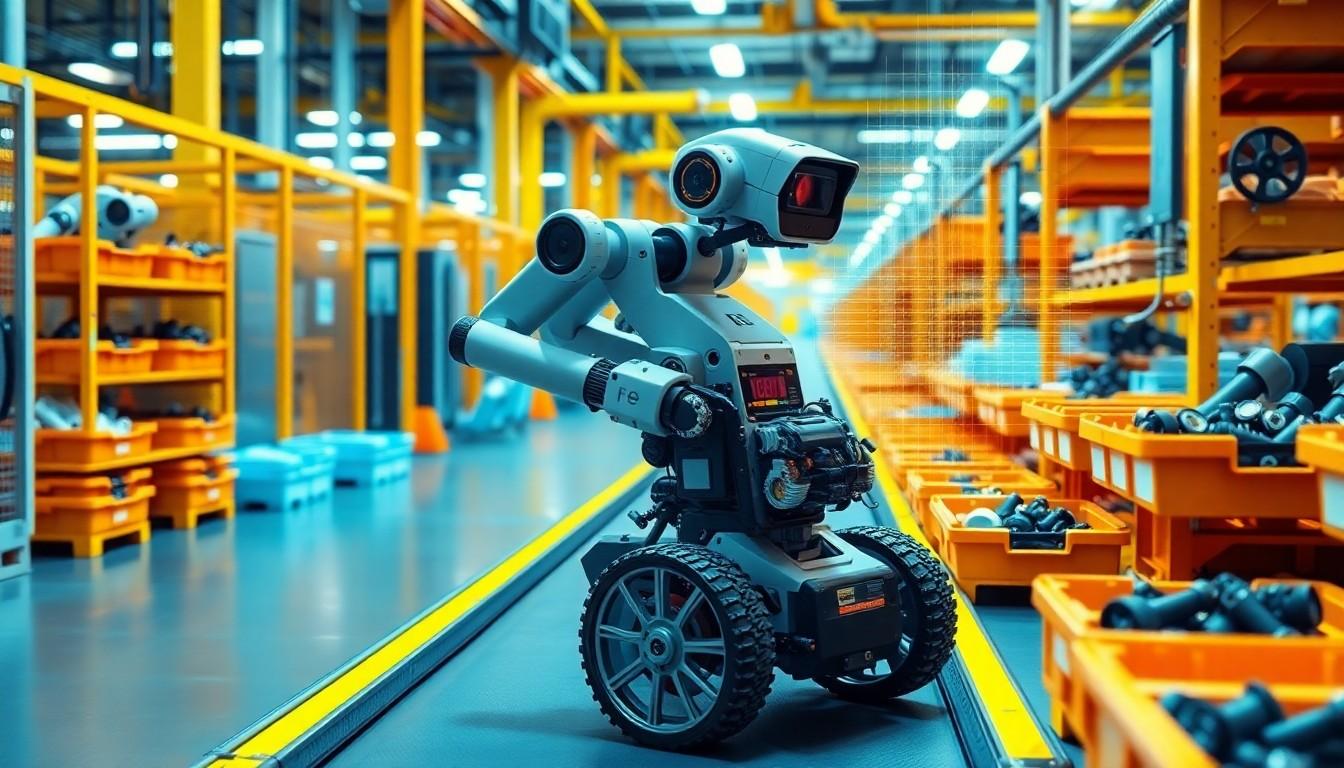
The robots being tested are built to operate at roughly human height, move on wheels and use two articulated arms to pick and place parts. That combination matters because it allows the machines to work in existing factory layouts without major changes to aisles or workstations. The challenge is not simply moving objects from one place to another, but recognising mixed parts inside deep containers and handling them gently enough to avoid damage. Industry reporting on the project says the aim is to prove that these systems can cope with the kind of parts sequencing that has long depended on human dexterity and judgement.
Before any robot is allowed onto the factory floor, Audi is testing the process in a virtual environment. The company says the work uses a digital twin, along with DELMIA, the 3DEXPERIENCE platform and NVIDIA Omniverse libraries, to assess cycle times, ergonomics, safety and overall feasibility. That approach reflects a broader shift in industrial manufacturing: complex systems are increasingly modelled and stress-tested in software before anyone commits to physical deployment. Audi’s Production Lab in Ingolstadt is intended precisely for that sort of experimentation, serving as a place to validate ideas under production-like conditions before deciding whether they are stable and scalable enough for series production.
Audi is also casting the trial as a way to reduce repetitive strain rather than as a direct replacement for large numbers of workers. The company argues that kitting and parts sequencing are tiring, repetitive and prone to error, and that automation could free staff for supervision, quality control and other higher-value tasks. That framing is consistent with other Audi research into component picking, including work at Böllinger Höfe with Fraunhofer institutes on artificial intelligence, computer vision, sensors and robotics to ease physical strain and improve accuracy in logistics processes.
For now, the Ingolstadt project remains a trial rather than a commitment to full-scale deployment. Audi has not announced a rollout date, and reporting on the initiative stresses that laboratory testing does not by itself prove production reliability or confirm long-term cycle times. Even so, the project shows how far industrial robotics has moved beyond fixed arms behind safety cages. If mobile humanoids can consistently sequence parts in a real factory setting, they could become a practical tool for modernising older plants without the costly disruption that usually comes with rebuilding an assembly line from scratch.
Source Reference Map
Inspired by headline at: [1]
Sources by paragraph:
Source: Fuse Wire Services