


Listen to the article
Austin-based Neurophos has raised $110 million in a Series A funding round led by Gates Frontier, aiming to revolutionise AI inference with photonic chips that use light to boost efficiency and speed.
Neurophos, an Austin startup spun out of Duke University, has closed a $110 million Series A round to accelerate development of photonic chips aimed at AI inference, according to company and industry accounts. The financing was led by Gates Frontier, with participation from Microsoft’s venture arm M12 and a group of strategic and climate-focused investors including Aramco Ventures, Carbon Direct Capital and Bosch Ventures. (Sources: Neurophos, TechCrunch)
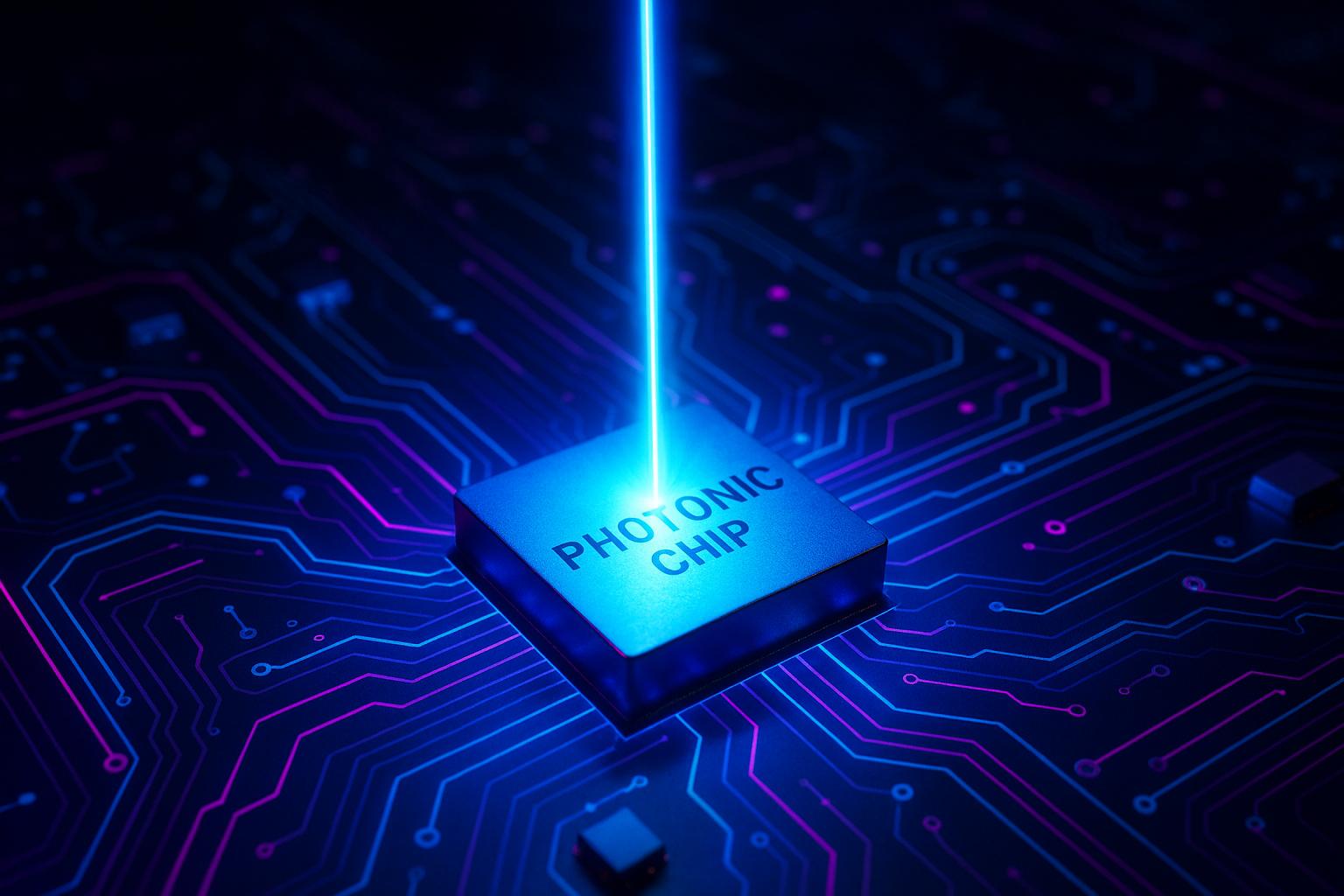
The company says its architecture replaces electron-based data movement with light, building what it calls an optical processing unit, or OPU, that integrates thousands of micron-scale optical elements on a single device. According to Neurophos, the approach is intended to cut the power required for common AI tasks and to enable denser, faster inference hardware than conventional silicon accelerators. (Sources: Neurophos, TechCrunch)
Neurophos’s technical foundation centres on a “metasurface modulator” that the firm describes as functioning like a photonic tensor core, performing matrix–vector multiplications , a core operation in neural network inference , directly in the optical domain. Industry reporting notes the company fits many such modulators on a chip to create a large-scale photonic array intended for datacentre use. (Sources: TechCrunch, Yahoo/TechCrunch summary)
The start-up and its backers frame the technology as a potential path to substantial improvements in energy efficiency and throughput for inference workloads, though the claims remain contingent on scaling the prototypes to datacentre-class modules and integrating a full software stack. The company has said the new funding will support work on integrated OPU modules, developer hardware and the accompanying software platform. (Sources: Neurophos, FinSMEs)
The fundraising comes as the AI accelerator market remains dominated by established GPU suppliers yet attracts growing interest in specialised alternatives for inference. Industry observers have highlighted efforts across the sector to develop targeted hardware that can lower operating costs and power consumption for deployed AI services. Neurophos’s backers, which include corporate venture arms and investors focused on energy transition, reflect that crossover interest. (Sources: TechCrunch, FinSMEs)
Neurophos reported the Series A was oversubscribed and that the round brings its total funding to roughly $118 million; the company said the capital will be used to move from prototype devices toward datacentre-ready systems and early-access developer platforms. Independent verification of performance at scale is not yet available, making broader adoption dependent on forthcoming technical benchmarks and integration with existing AI stacks. (Sources: Neurophos, FinSMEs)
Source Reference Map
Inspired by headline at: [1]
Sources by paragraph:
Source: Fuse Wire Services