


Listen to the article
With over 11,000 data centres worldwide, a new map reveals the US’s outsized role and highlights industry adaptations to rising temperatures and regional inequalities in digital infrastructure deployment.
Actualmente existe una enorme y creciente huella física detrás de la nube: un mapa interactivo elaborado a partir de Data Center Map sitúa en más de 11.000 el número de centros de datos operativos en todo el mundo, y muestra una distribución claramente desigual que desmiente la idea de una red verdaderamente descentralizada. According to the report by Xataka, la mayoría de esas instalaciones está en el hemisferio norte y un solo país acapara una porción sustancial del total. [1][2]
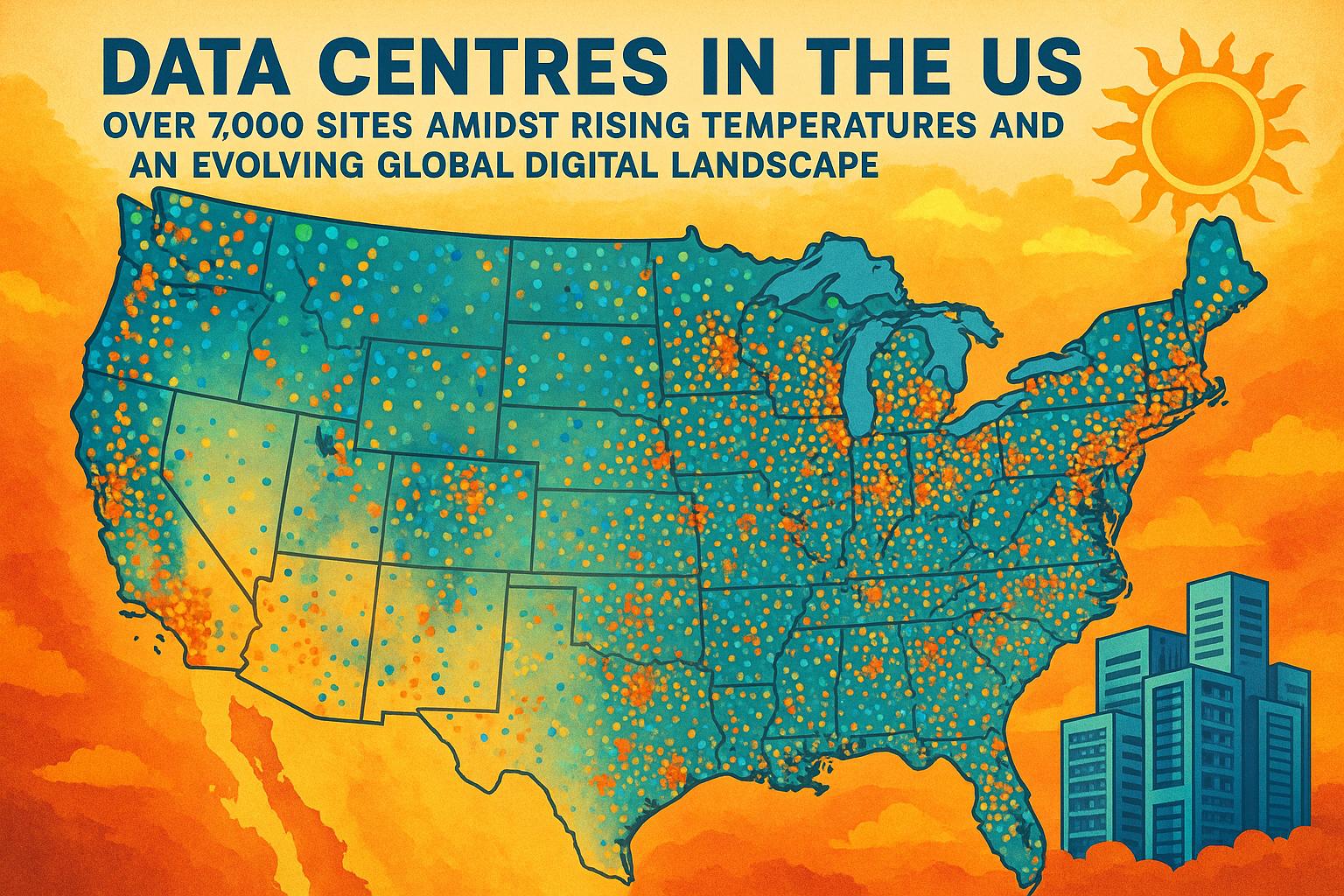
The United States emerges as the dominant hub. According to the report by Xataka, the country hosts 4,303 data centres, with pronounced regional clusters: the state of Virginia alone accounts for hundreds of facilities. Industry mappings published by Visual Capitalist corroborate the concentration within US states, listing Virginia, Texas and California among the leaders, while more recent country-level tallies compiled by sector analysts show even larger totals for the United States, underscoring its outsized role in global digital infrastructure. [1][5][4]
Location is driven by more than geography: cooling and energy costs shape placement. Xataka cites the American Society of Heating, Refrigerating and Air-Conditioning Engineers’ guidance that the ideal operating temperature range for data halls sits between 18°C and 27°C, and notes that higher ambient temperatures increase electricity and water demand for cooling. That technical constraint helps explain why many providers historically favoured cooler climates, even as other factors now pull capacity into warmer regions. [1]
Yet demand is rising rapidly in tropical and subtropical markets. According to the Xataka piece, countries such as Indonesia and Brazil already host large numbers of centres, Indonesia and Brazil figure high on global lists, while Singapore, despite being small, shows very high density. Major cloud operators also keep growing footprints across Asia: Google’s public data-centre listings, for example, include facilities in Taiwan, Thailand, Japan, Malaysia and Singapore, reflecting the industry imperative to locate capacity near users. [1][3][2]
That geographic expansion raises a technical challenge: how to keep kit cool where ambient temperatures and humidity are high. The Xataka article, citing research by Rest of World, describes industry experiments and collaborations, particularly in Singapore, aimed at cooling systems tailored to hot, humid climates. Hybrid approaches that combine air- and water-based cooling, subterranean siting in extreme-heat regions and even underwater trials in China are being evaluated as operators seek efficiency without sacrificing proximity to local markets. The company claims and research efforts reported suggest the sector is adapting, but not without trade-offs in energy and water demand. [1]
Tools and industry data illustrate both opportunity and concentration. ColoCapacity’s interactive maps and regional inventories offer granular views of facilities by continent and provider, while analysts at DataX Connect highlight favourable locations such as parts of the United States, Singapore, Japan and northern Europe for their balance of energy security and demand. Together these sources show an industry optimising for latency, regulatory preferences and supply-chain realities even as capital pours into new markets. [2][6][7]
The pattern is clear: sovereignty and proximity to users are increasingly prioritised, even at the expense of operating in sub‑optimal climates. That trade-off matters because, as ambient temperatures climb and extreme weather becomes more frequent, installations currently manageable may require costly retrofits or new cooling technologies. According to Xataka’s reporting and data cited therein, the sector faces a policy and engineering moment, balancing national data residency objectives, sustainability goals and the physical limits imposed by heat and water scarcity. The choices made now will shape operational risk and energy demand across the global digital economy. [1][4][7]
📌 Reference Map:
##Reference Map:
- [1] (Xataka) – Paragraph 1, Paragraph 2, Paragraph 3, Paragraph 4, Paragraph 5, Paragraph 7
- [2] (ColoCapacity) – Paragraph 1, Paragraph 6
- [3] (Google) – Paragraph 4
- [4] (Cargoson) – Paragraph 2, Paragraph 7
- [5] (Visual Capitalist) – Paragraph 2
- [6] (ColoCapacity regions) – Paragraph 6
- [7] (DataX Connect) – Paragraph 6, Paragraph 7
Source: Fuse Wire Services