


Listen to the article
Leaked details suggest Apple’s first foldable iPhone will prioritise a slim profile and durability, opting for side-mounted Touch ID over Face ID, with a focus on innovative hinge and display technologies to address common foldable issues.
A flurry of fresh leaks suggests Apple is shaping its first foldable iPhone as a “wide foldable” that favours thinness and long-term durability over some familiar features, potentially altering the biometric and display trade-offs customers expect from the iPhone line. According to the report in Benzinga, details originating from Weibo leaker Digital Chat Station describe a horizontally oriented, book-style device with a large internal display designed more for productivity and media consumption than pocketable compactness. [1]
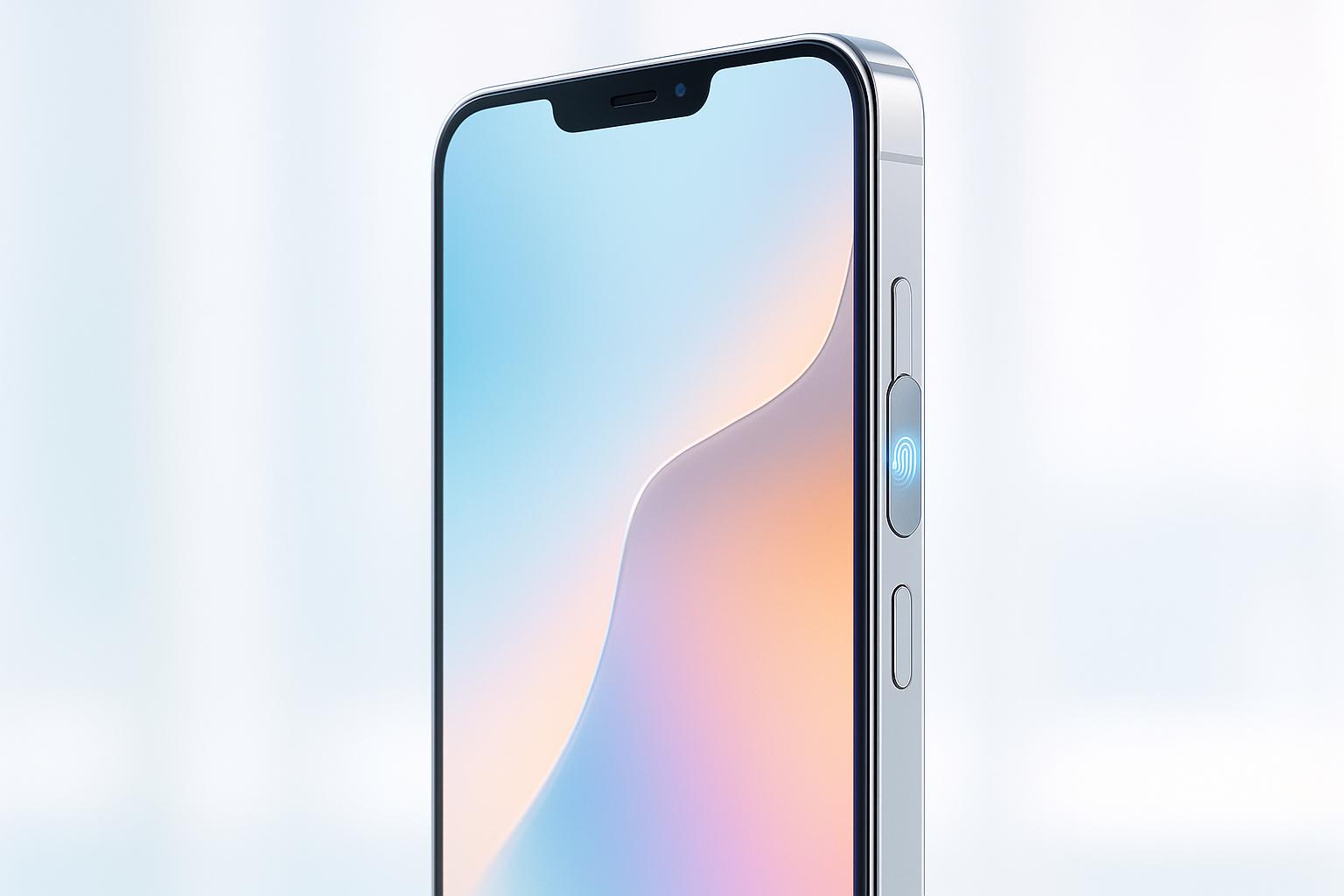
Central to the rumored design is a return to fingerprint authentication. The leaker says Apple is likely to skip Face ID in favour of a side-mounted Touch ID sensor, integrated into the power button to save internal space and preserve a slimmer profile. Benzinga notes this move is being made to prioritise thinness and internal packaging, and MacRumors has echoed the same assertion, adding that Face ID’s sensor array would be “too thick” for the company’s targeted chassis dimensions. [1][4]
Durability appears to be a clear engineering priority. The Benzinga summary quotes the leak describing the hinge as “very strong”, and MacRumors reports Apple is exploring advanced hinge materials such as a metallic glass hinge designed to resist deformation and reduce creasing. Industry reporting indicates Apple may also adopt a laser‑drilled metal display plate to disperse bending stress, a component already linked to “crease-free” claims for forthcoming foldables. Those measures together signal Apple is aiming to address two of the most persistent consumer complaints about foldables, screen creasing and hinge failure. [1][2][3]
Display specifications emerging from the leaks are consistent across outlets: the inner screen is expected to measure roughly 7.8 inches when unfolded while the external cover display would sit around 5.5 inches. Benzinga’s summary cited a 7.58-inch internal panel and a smaller 5.25-inch external panel in its earlier leak; MacRumors coverage consolidates these figures and adds that the inner display may employ in-cell touch technology to cut thickness and improve touch responsiveness, though integrating such a stack on a foldable OLED presents additional mechanical and durability challenges at the hinge. [1][5][3]
Camera and external‑design compromises are also being discussed. The Benzinga piece says the prototype would use an under-panel selfie camera on the internal display and a punch‑hole camera on the external screen, calling into question whether interface elements such as Apple’s Dynamic Island will transfer to the outer panel. On the rear, reports point to a dual 48‑megapixel camera setup with larger sensors, underscoring Apple’s continued emphasis on imaging even as it navigates new form-factor constraints. [1]
The broader market context sharpens the stakes. Benzinga highlights Samsung’s recent Galaxy Z TriFold and its plans for early 2026 U.S. availability as evidence that rivals are accelerating innovation in foldables; industry analysts have also suggested Samsung and Apple may share certain advanced display components, with Fine M‑Tec named as a supplier of stress‑dispersing metal plates used to achieve “crease‑free” screens. That dynamic could mean Apple is both borrowing from and reacting to moves by long‑time competitors as it determines which compromises , biometric systems, display treatments or hinge robustness , are acceptable for an inaugural foldable iPhone. [1][3]
Apple has not commented on these reports. According to the Benzinga article, Digital Chat Station’s prior track record on iPhone designs lends weight to the claims, while MacRumors and other industry reports supply material details about materials, display architecture and component suppliers; taken together, the leaks portray a device that privileges a thin, durable construction even if that means sacrificing Face ID and adopting a more compact biometric solution. Consumers and competitors will likely watch closely as component-level reporting and manufacturing signals converge on what could be Apple’s most consequential industrial design decision in years. [1][2][3][4][5]
📌 Reference Map:
##Reference Map:
- [1] (Benzinga) – Paragraph 1, Paragraph 2, Paragraph 5, Paragraph 6, Paragraph 7
- [2] (MacRumors) – Paragraph 3, Paragraph 7
- [3] (MacRumors) – Paragraph 3, Paragraph 4, Paragraph 6, Paragraph 7
- [4] (MacRumors) – Paragraph 2, Paragraph 7
- [5] (MacRumors) – Paragraph 4, Paragraph 7
Source: Fuse Wire Services