


Listen to the article
The Irish Government’s Large Energy User Action Plan (LEAP) seeks to attract investment in energy-intensive sectors by developing green energy parks and upgrading infrastructure, sparking debate over environmental impact and energy security.
The Irish Government has published the Large Energy User Action Plan (LEAP), a strategy designed to attract investment in highly energy‑intensive sectors such as data centres, semiconductors, pharmaceuticals and precision engineering by combining industrial development with renewable energy provision. The cabinet approved the plan on 13 January, and the Government says it will use a “plan‑led” approach to identify green energy parks that co‑locate energy‑intensive users with indigenous renewable resources, including offshore wind. [1][3]
According to the published strategy, LEAP will “pro‑active planning to co‑locate very energy‑intensive industrial sites with renewable energy generation and other energy infrastructure will substantially improve coordination of private and public investment decisions.” The plan sets out 17 key actions to align industrial development with energy infrastructure and wider planning priorities. It envisages green energy parks supplied by private developers and informed by a forthcoming National Planning Statement and related policies. [1][3]
Minister for Enterprise, Tourism and Employment Peter Burke said the plan will help regions attract investment in the “next generation of strategic industry, promoting long‑term economic development and providing further employment across the regions.” He added that LEAP will “enhance Ireland’s proposition as a world‑class place to do business in and as strategic knowledge‑intensive regional hub for the ICT sector, where a secure, sustainable energy system supports innovation, investment and long‑term industrial growth.” [1][7]
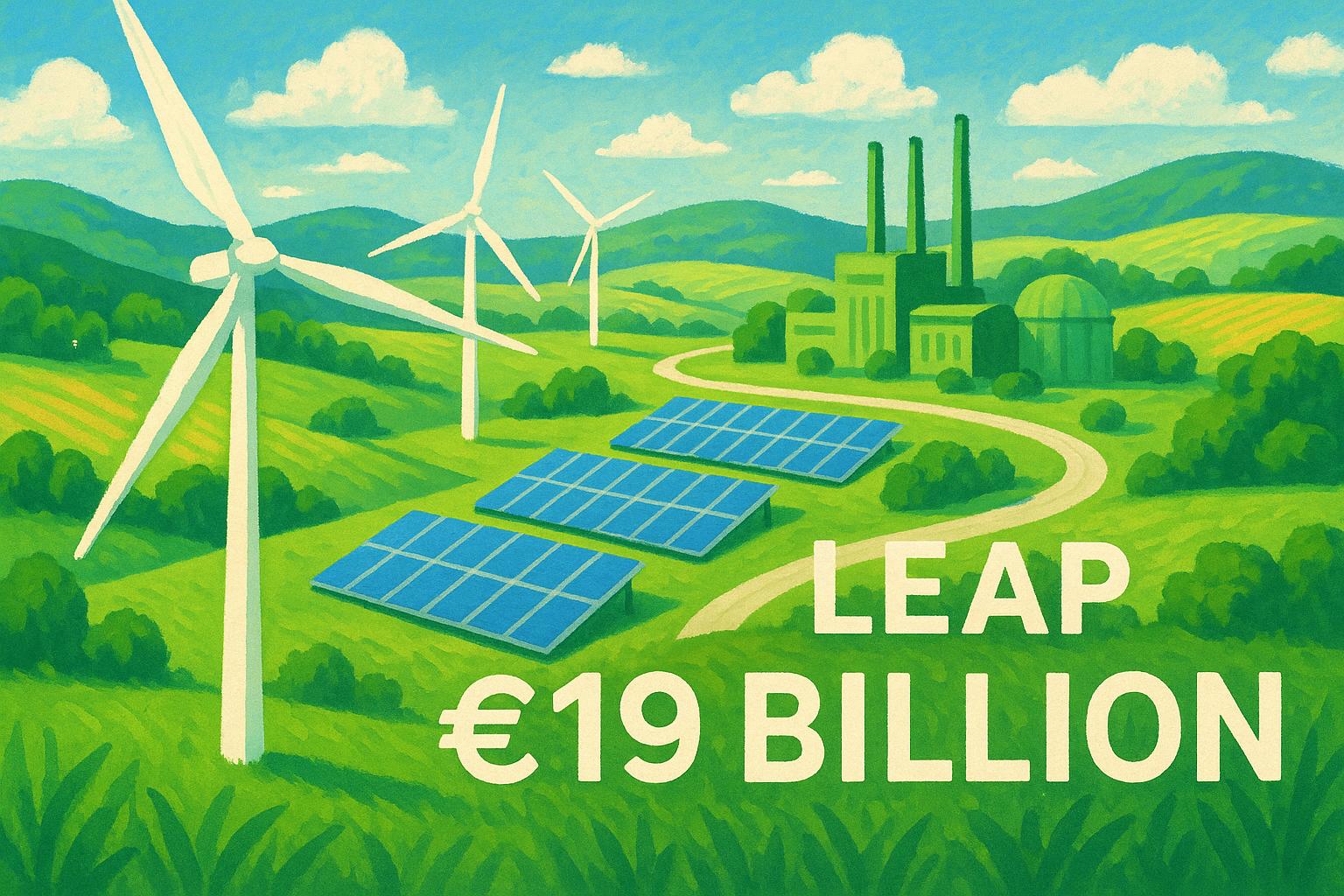
Government and industry commentators point to the economic stakes involved. Officials estimate that constraints on planning and energy infrastructure have cost Ireland about €10 billion in foregone investment from energy‑intensive firms. The Irish Times reports the new plan aims to unlock nearly €19 billion of public and private investment in the electricity network over the next five to ten years to support these large users. LEAP is explicitly pitched as a means to make Ireland competitive for future hyperscale projects while aligning them with national decarbonisation goals. [1][2]
The scale of the challenge is stark. Data centres already directly employ roughly 21,000 people in Ireland while consuming more than 20% of the country’s electricity. Since 2015, electricity used by data centres rose from about 5% of total demand to 21%, and data centre and new tech load is projected to almost double from 7.1 TWh in 2023 to 13.3 TWh in 2032, amounting to roughly 30% of all electricity demand in 2032. Independent analysis by Wood Mackenzie, produced with Pinergy, projects data centres could use an estimated 8.6 TWh by 2030 , roughly the annual consumption of two million homes , a rise accelerated by demand for AI. Globally, data‑centre electricity demand is also forecast to surge as AI drives higher loads. [1][4]
Regulatory safeguards have been introduced alongside planning changes. The Commission for Regulation of Utilities (CRU) has required that data centres secure at least 80% of their annual demand from additional renewable electricity projects in Ireland, and its new Large Energy Users Connection Policy adds conditions such as new onsite or proximate dispatchable generation and careful consideration of connection locations in constrained regions. The CRU has provided lead‑in times recognising the complexity of developing dedicated renewable capacity. These measures are framed as attempts to balance growth with energy security and Ireland’s decarbonisation commitments. [1][5][6]
The announcement has provoked criticism from environmental groups and local campaigners concerned about climate impacts, pressure on the electricity system, rising energy prices and competition with other planning priorities such as housing, transport and water. Critics argue that clustering large energy users near constrained networks risks crowding out other users and increasing costs for ordinary households, and some have urged tighter controls or pauses until new renewable capacity is firmly in place. The Government contends the LEAP approach preserves the possibility of developments outside designated parks while ensuring consistency with wider planning and green transition aims. [1][7]
Implementation of LEAP will proceed alongside the National Planning Statement, the CRU connection policy and the Government’s updated Statement on the Role of Data Centres in Ireland’s Enterprise Strategy. Officials say the combination of plan‑led site identification, regulatory conditions and investment in grid infrastructure is intended to provide clarity to investors while trying to safeguard energy security and advance the twin digital and green transitions. How effectively those safeguards deliver additional renewable generation ahead of new load growth will determine whether the strategy reconciles economic ambition with the energy and climate concerns raised by critics. [3][6][7]
📌 Reference Map:
- [1] (Silicon Republic) – Paragraph 1, Paragraph 2, Paragraph 3, Paragraph 4, Paragraph 5, Paragraph 6, Paragraph 7, Paragraph 8
- [3] (Department of Enterprise, Trade and Employment , LEAP) – Paragraph 1, Paragraph 2, Paragraph 8
- [7] (Government press release) – Paragraph 3, Paragraph 7, Paragraph 8
- [2] (The Irish Times) – Paragraph 4
- [4] (Wood Mackenzie/Pinergy report via Irish Examiner summary) – Paragraph 5
- [5] (Irish Examiner summary of CRU requirement) – Paragraph 6
- [6] (DLA Piper summary of CRU connection policy) – Paragraph 6, Paragraph 8
Source: Fuse Wire Services